0755-25921519
  0755-25921519
 📑 Table of Contents
- 1. Core Conclusion: Yes, But Not "Just Register a Company"
- 2. 7 Mandatory Requirements for Eligibility
- 3. 9 Common Pitfalls Most Foreign Founders Fall Into
- 4. Complete Process: From Company Registration to Legal Residence
- 5. Why Use a Professional Service Provider?
- 6. Shengtian Business: One-stop Startup & Visa Service
- 7. Frequently Asked Questions
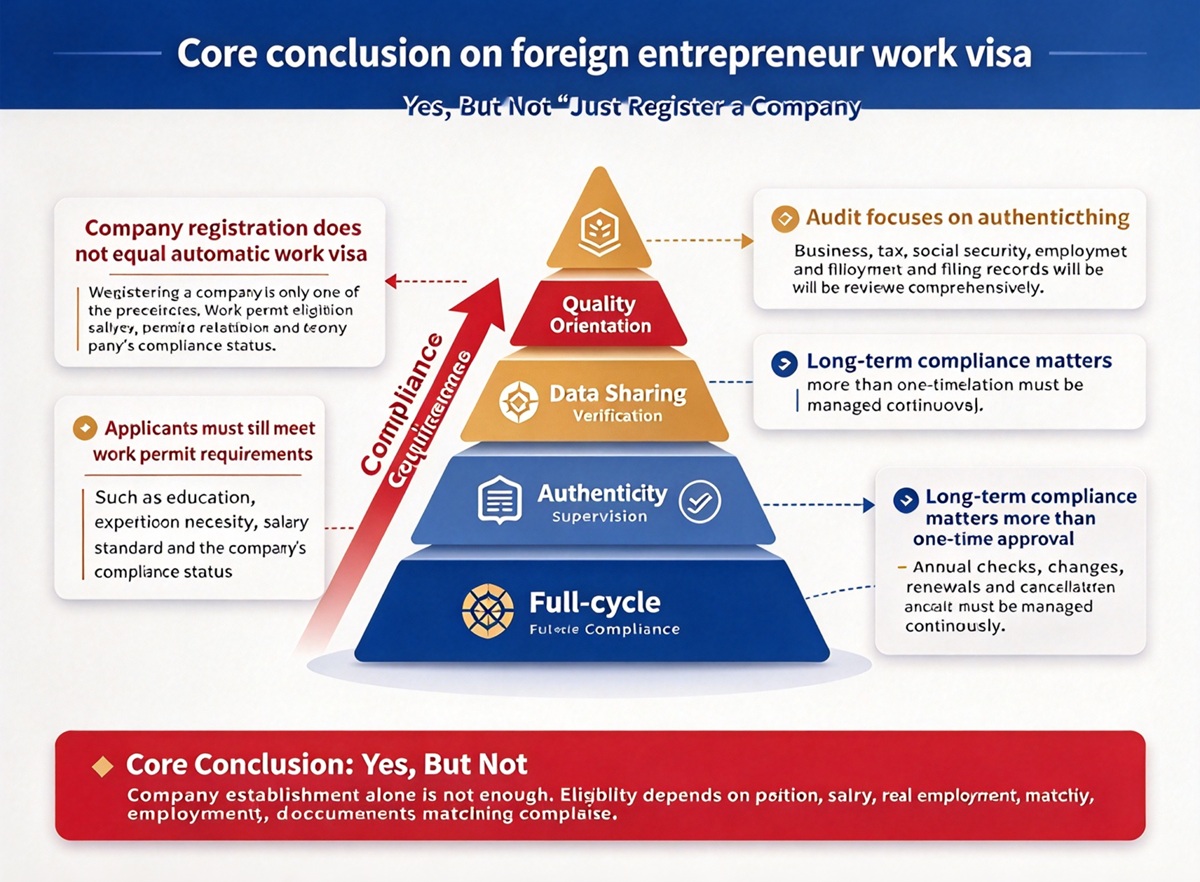
1. Core Conclusion: Yes, But Not "Just Register a Company"
As Shenzhen continues to optimize its business environment, more and more foreign investors and entrepreneurs come to set up companies and operate businesses. There is a very common misconception among many foreign founders and legal representatives:
"I registered the company. I am the boss / legal representative. I work in my own company, so why would I need a separate work visa?"
Many people assume work permits are only for "employees", not for business owners. But when inspected by authorities, they realize the hard truth: owning equity in a company, and having legal employment status in China, are two completely separate legal concepts.
Equity Status ≠ Employment Status
From a legal perspective:
- Shareholder / Legal Representative status: This is a business registration identity, representing ownership and representation rights. It answers the question "who owns the company".
- Work Permit / Employment status: This is a labor and immigration status, granting legal authority to work in China. It answers the question "can you legally work in China".
These are two separate systems, managed by two different government departments, with two separate sets of rules. Even if you are a 100% shareholder and the legal representative of the company, as a foreign national, if you engage in work, operation or management activities within China, you must legally obtain a Foreigner's Work Permit and a corresponding Work-type Residence Permit.
Working in your own company without a valid work permit is legally the same as "illegal employment". Both the individual and the company bear corresponding legal liabilities.
The Correct Path: Self-employment via Your Own Company
Essentially, when a foreign founder applies for a work permit for themselves, the process is: your wholly-owned company acts as the employer, and sponsors your work permit application through the standard official foreign work permit process.
This path is fully legal and compliant, and is supported by national policies encouraging foreign talent to invest and start businesses in China. However, the company must be fully compliant, the position must be genuine, qualifications must meet standards, and all procedures must be followed properly. No requirements can be skipped.
There is no special "founder channel" or shortcut. You will be held to the same standards, follow the same procedures, and undergo the same reviews as any other foreign employee. In fact, because it is self-employment, reviews of company authenticity and position necessity tend to be stricter, not more lenient.
2. 7 Mandatory Requirements for Eligibility
While it is allowed, the application standards are exactly the same as for regular employees — in some aspects even stricter for self-employed founders. It is not enough to "just have a business license".
Requirement 1: Legitimate Company with Valid Foreign Expert Filing
This is the fundamental prerequisite. Your company itself must be legally compliant and qualified to employ foreign nationals.
Specific Requirements
- Legally registered: A foreign-invested or Sino-foreign joint venture company duly registered in Shenzhen, with a valid business license, normal industrial and commercial status, no operational abnormalities, revocations or cancellations.
- Actual operations: Must have a real business address and office space. Virtual addresses or shell companies are not acceptable. You must provide office lease agreements or property ownership proofs.
- Real business activity: Must have actual business transactions, bank flows, tax records, and supporting business documents. A company with only a license and no actual operations will not pass review.
- Foreign work permit unit filing: The company must complete the "Unit Filing for Foreign Expert Work Permit" with the foreign work permit authority, to obtain official qualification to hire foreign personnel. Without this filing, no work permit applications can be made.
Common pitfall: Many founders apply for a work permit immediately after registering the company, completely unaware of the required unit filing. Applications are rejected directly, wasting weeks of time.
Requirement 2: Genuine Position Matching Business Scope
Your position in the company cannot be arbitrary. The role must genuinely exist, be highly relevant to the company's business, and meet the appropriate talent classification standards.
Specific Requirements
- Position seniority: Typically senior management roles such as Legal Representative, Executive Director, General Manager, CTO, COO, CFO, or core technical leadership positions. The role must meet the criteria for Category A (high-end) or Category B (professional) foreign talent.
- Business alignment: Job responsibilities must closely match the company's business scope. For example, a trading company can hire an International Trade Director; a tech company can hire a Technical Director. A cross-border e-commerce company cannot hire a "Music Producer" with no related business line.
- Clear job descriptions: Detailed position descriptions and company organization charts must clearly show the position's level, authority and scope of responsibility.
- Necessity rationale: There must be a justifiable reason why the position must be filled by a foreign national rather than a local hire. The founder's own international background, overseas resources and technical expertise can serve as justification.
Common pitfall: Using vague titles like "manager" or "employee" that are too junior or unrelated to the business. Applications are often rejected directly, or even suspected of being fabricated solely for visa purposes.
Requirement 3: Compliant Salary with Three-way Consistency
Even if you own the company, you must pay yourself a salary that meets the official standards for the corresponding talent category. Zero salary or nominal salaries are not acceptable.
Specific Requirements
- Salary standard: According to the latest Shenzhen benchmarks, Category A high-end foreign talent must earn no less than 6 times the local average social salary; Category B professional talent must earn no less than 4 times the average. Salary is one of the core criteria for talent classification.
- Three-way consistency rule: The salary stated in the labor contract, the salary shown on bank statements, and the individual income tax filing records must match in amount and be continuous over time. This is a core hard verification standard.
- Social security contributions: Social insurance must be paid in accordance with regulations, with a contribution base reasonably matching the salary level.
- Corporate account payment: Salaries must be paid from the company's corporate bank account, clearly labeled "salary". Payments from personal accounts or cash payments are not recognized.
Common pitfall: Believing "the money is all mine anyway, no need to pay a salary", or paying a token salary of a few thousand RMB. If the salary fails to meet the standard, the application will be rejected outright. Underpaying also violates labor laws in China.
Requirement 4: Personal Qualifications Matching Talent Category
Being a business owner does not lower the personal qualification bar. You must still meet the standard eligibility criteria for foreign work in China.
Specific Requirements
- Education: Generally Bachelor's degree or above. Higher education improves approval odds. Category A typically requires a Doctorate or senior professional title.
- Work experience: Relevant work experience in the corresponding field, with a matching industry background.
- No criminal record: A clean criminal record certificate from the home country, completed with consular authentication.
- Age requirement: Generally 18 years of age or older, below statutory retirement age. Age limits may be relaxed for Category A high-end talent.
- Points system: Applications can also be evaluated via a points-based system. 60+ points qualify for Category B; 85+ points qualify for Category A.
Common pitfall: Assuming that being the boss lowers the bar. It does not. Review standards are identical to those for regular employees.
Requirement 5: Three-level Authentication of Overseas Documents
All documents issued outside China must complete the full authentication chain to be legally recognized in China.
Specific Requirements
- Education certificates: Degrees and diplomas issued by overseas universities must be notarized locally, authenticated by the home country's foreign ministry, and then authenticated by the Chinese embassy / consulate in that country.
- No criminal record certificate: Issued by the official authorities of the nationality country, and completed with the same three-level authentication chain. Usually valid for 3–6 months — be careful not to let them expire.
- Other supporting documents: Overseas work experience letters, professional qualifications, etc., must also be authenticated if used in the application.
- Chinese translation: All foreign-language documents must be accompanied by an official Chinese translation with the translation agency's official stamp.
Common pitfall: Submitting original overseas documents directly without consular authentication. They are simply not legally recognized, and applications are rejected outright, causing 1–2 month delays.
Requirement 6: Legal Residence Status & Proper Visa
Entry status must be legal. You cannot start working on a tourist visa.
Specific Requirements
- Correct entry visa: Generally you must enter China with a Z-class Work Visa. Entry on a tourist or business visa does not allow you to start work immediately, nor can you convert directly to a work permit in most cases (except for special cases such as Category A high-end talent).
- Timely document processing: Apply for the formal Foreigner's Work Permit within 15 days of entry, and apply for a Work-type Residence Permit within 30 days. Both are statutory deadlines.
- Matching residence purpose: The residence purpose must be listed as "Work", matching the employment status.
Common pitfall: Entering on a tourist visa to set up the company, meet clients and run operations, assuming "running my own company isn't working". This is still illegal employment and illegal residence. Penalties include fines and mandatory exit.
Requirement 7: Ongoing Compliance & Annual Management
Approval is not the end of the process. Ongoing management is equally important.
Specific Requirements
- Annual verification: Work permits require annual verification to confirm continued employment, salary compliance and valid residence status.
- Renewal before expiry: Initiate renewal of work permit and residence permit 1–2 months before expiry.
- Change filings: Any changes to company information, position or salary must be promptly updated with the authorities.
- Cancellation on exit: If the company closes or you leave the position, cancel the work permit promptly.
Common pitfall: Filing and forgetting. No annual verification, no renewal. Documents expire without the holder knowing, and violations are only discovered during inspection.

3. 9 Common Pitfalls Most Foreign Founders Fall Into
Based on extensive local case data in Shenzhen, the vast majority of first-time foreign entrepreneur applicants fall into the following pitfalls. Many seem minor, but ultimately lead to rejection or compliance risks.
Pitfall 1 Shell Company Trap – Registering Only for Visa
This is the most common mistake. Many people register a company solely for visa purposes, with a virtual address, no actual office, no business, no staff, no bank flow, no tax filings — a pure "shell company".
While looser review standards may have allowed this in the past, with today's substantive compliance reviews, shell company work permit applications have a near-zero approval rate. If found to be fraudulently registered to obtain a visa, permanent negative records are created, affecting all future visa applications.
Pitfall 2 Position Unrelated to Company Business
For example, the company's business scope is international trade and supply chain, but the position applied for is "Senior Software Engineer", while the company has no R&D department, no software products, no relevant team or projects.
A position completely disconnected from the business will raise immediate red flags: that the role does not need to exist, and was created solely to secure a visa for the founder. Applications are rejected directly; in serious cases, the authenticity of the enterprise itself is investigated.
Pitfall 3 Zero or Nominal Salary Below Standard
Assuming "it's my company, money moves from my left pocket to my right pocket — no need for a real salary", or paying a token 3,000 RMB per month with minimum base social security and tax.
The resulting salary falls far below the official talent category standards, and applications are rejected outright. From a labor law perspective, even legal representatives are entitled to be paid a salary and have social security contributions. Zero salary is itself non-compliant.
Pitfall 4 Forgetting the Foreign Expert Unit Filing
Company is registered, business license in hand, and work permit application is submitted immediately — without knowing that a separate "foreign work permit unit filing" is required first.
Companies must complete this filing first to obtain the qualification to hire foreign staff. Applications submitted without this filing are not accepted at all, causing major delays through back-and-forth resubmissions.
Pitfall 5 Starting Operations on a Tourist Visa
Many foreign entrepreneurs enter on a tourist visa, rent an office, register the company, meet clients, negotiate deals, hold kickoff meetings — busy building their business.
They assume "I'm here to start my own company, not to work for someone, so I don't need a work visa". But in reality, conducting business and management activities within China is, by definition, working / employment. Operating on a tourist visa constitutes illegal employment. If caught: fines, mandatory exit, and lasting negative impact on all future Chinese visa applications.
Pitfall 6 Confusing Legal Representative Status with Employment Status
"I'm the legal representative, I speak for the company — why would I need a work permit?" This is the single most frequently asked question.
Legal representative status is a business registration authority; work permit is an immigration authority. They are completely separate things. Legal representative status cannot substitute for a work permit. If you are a foreign national working in China, you need one — boss or not.
Pitfall 7 One-Person Company with No Other Staff
The company has only the legal representative, no other employees, no social security contributions, no team.
This scenario raises high suspicion about the authenticity of the company and the necessity of the position. A one-person foreign-owned company will have a very hard time convincing the review authority of genuine business activity and staffing need. It is advisable to have reasonable staffing or strong supporting business evidence.
Pitfall 8 No Bookkeeping, Tax Filing or Annual Reporting
After registration, the company is left dormant: no bookkeeping, no tax declarations, no annual industrial and commercial reports.
This leads to business abnormalities and tax irregularities. Abnormal enterprise status directly impacts work permit applications and annual reviews. Companies with serious operational anomalies cannot apply for any foreign work permits.
Pitfall 9 Assuming Company Ownership Grants Permanent Residence
Many people assume "if I start a company in China, I automatically qualify for permanent residence".
This is not the case. Investment-based permanent residence has its own separate criteria regarding investment amount, tax contributions, local employment generation, etc. Simply opening a company does not automatically qualify you for PR. If applying via the employment-based path, standard work tenure and residence time requirements still apply.

4. Complete Process: From Company Registration to Legal Residence
For foreign entrepreneurs setting up a company and obtaining their own work permit in Shenzhen, the complete process consists of 7 major steps. Order matters and no step can be skipped.
Step 1: Establish a Foreign-invested Enterprise
First, register a foreign-invested (or joint venture) company in Shenzhen, completing full business registration, tax registration, bank account opening, social security account opening and all other corporate setup procedures.
- Design the business scope to match the position you will later apply for;
- Use a real office address rather than a pure virtual registered address;
- Ensure registered capital and contribution methods comply with foreign investment regulations;
- Obtain business license, company seals, financial seal, legal representative seal, and open a corporate bank account.
If you already have an established company, skip this step and directly verify that the company status is normal.
Step 2: Complete Foreign Work Permit Unit Filing
Prepare full company documentation and file for the "Foreign Work Permit Unit Filing" with the Shenzhen Science and Technology Innovation Bureau (Foreign Expert Bureau).
- After filing is approved, the company officially qualifies to employ foreign personnel;
- This is the step most entrepreneurs miss entirely — it must be done first;
- With complete documentation, filing takes approximately 3–5 working days.
Step 3: Apply for Foreigner Work Permit Notification
As the employer, the company submits a work permit application on your behalf to the foreign work permit authority.
- Prepare all required documentation: company qualifications, authenticated education, authenticated clean criminal record, labor contract, position description, organization chart, salary proof, office proof, etc.;
- File the application online via the official system, upload all electronic documents, and book an in-person window appointment;
- After approval, you receive the Official Foreigner Work Permit Notification — the prerequisite document for applying for a Z visa overseas.
Note: At this stage, the applicant is normally outside of China, to facilitate subsequent Z visa processing. If already inside China, eligibility for in-country change depends on specific conditions.
Step 4: Obtain Z-class Work Visa Overseas
With the Official Foreigner Work Permit Notification, apply for a Z-class Work Visa at a Chinese embassy or consulate abroad.
- Generally processed at the Chinese embassy / consulate in your home country or country of residence;
- Can also be processed at nearby consulates such as Hong Kong for faster turnaround and lower cost;
- Once approved, the Z visa is affixed to your passport, granting you entry to China for work purposes.
Note: If you are already in China and meet conditions such as Category A high-end talent status, you may be eligible for in-country status change. If you do not qualify, you must exit China to apply. Do not attempt to convert from a tourist visa.
Step 5: Enter China
Enter China with a valid Z-class Work Visa. Clear immigration control at the port of entry and receive an entry stamp.
- Confirm visa and entry stamp are clear and complete;
- Record your entry date clearly — all subsequent timelines are calculated from this date;
- Initiate follow-up paperwork promptly after entry — do not let deadlines pass.
Step 6: Collect Formal Foreigner's Work Permit Card
Within 15 days of entry, apply to receive the formal physical Foreigner's Work Permit card.
- Submit formal application and verify original documents;
- After approval, the physical work permit card is produced;
- This is your official legal employment credential in China.
Step 7: Apply for Work-type Residence Permit
Within 30 days of entry, apply for a Work-type Residence Permit with the public security immigration authority.
- Apply with work permit, company documents, accommodation proof, passport and visa, etc.;
- Biometric information (photo, fingerprints) is collected;
- After approval, you receive your Work-type Residence Permit, either as a sticker in your passport or as an electronic residence card.
Once you have your residence permit, the entire process is complete. You can now legally work, manage and operate your company in China.
Ongoing: Annual Compliance Management
- Complete annual work permit verification on time each year;
- Initiate renewal 1–2 months before expiry;
- Promptly file changes when company information, position or salary change;
- Cancel work permit promptly if the business ceases operations.

5. Why Use a Professional Service Provider?
Many founders assume: "it's just registering a company and submitting forms — I can do it myself and save money."
But anyone who has gone through the process knows: there are too many pitfalls, too many procedures, too many departments. The time cost, opportunity cost and trial-and-error cost of doing it yourself are far higher than the service fee.
1. Save time: No need to research every department's rules
The full process involves industrial and commercial bureaus, tax authorities, science & technology / foreign expert bureaus, immigration authorities, and Chinese embassies and consulates abroad — multiple departments, multiple systems, each with their own rules.
Doing it yourself means researching policy after policy, visiting department after department, resubmitting after each rejection. Professional service providers do this every day — they know what each step requires, how to prepare for smooth approval, and how to avoid common pitfalls.
2. Reduce risk: Pre-screen issues before submission
Trying it yourself means a high chance of falling into one of the 9 pitfalls listed above. At best you delay approval; at worst you create permanent negative records affecting future visas and permanent residence.
A professional provider will screen your situation in advance: company status, position structure, salary level, document completeness, authentication validity. Issues are fixed before submission, minimizing risk.
3. Focus on your business, not paperwork
An entrepreneur's most valuable asset is time and energy. You should focus on business, product and market — not studying policies, running between government offices and correcting paperwork.
For a small service fee, you outsource the entire identity and compliance process. You focus on running your company. The math works in your favor.
4. Long-term planning: Permanent residence roadmap
Professional services do not stop at getting your first visa approved. They can help you plan long-term: how to structure salary, how to manage residence time, how to accumulate qualifying years, and how to eventually apply for Permanent Residence.
Many people who handle it alone stop at the work permit stage with no long-term plan. By the time they want to apply for PR, they find that years have not been counted properly or records have gaps, wasting years of progress.
6. Shengtian Business: One-stop Startup & Visa Service
Based in Shenzhen with years of experience in foreign work permits and residence services, Shenzhen Shengtian Business Consulting has served large numbers of foreign investors, founders and executives. We know the full Shenzhen process from company registration to foreign expert filing, work permit and residence permit, and we know local approval standards.
Our Services Include
- Company setup assistance: Foreign-invested company registration consulting, business scope planning, registered address recommendation, and work permit unit filing — all handled in one go.
- Free qualification assessment: Based on your education, experience, position and company situation, we assess feasibility, recommend the best talent category, and give you clear approval odds.
- Tailored application optimization: Custom-built position structure, salary arrangement and document framing for self-employed cases, emphasizing authenticity and reasonableness to maximize approval rates.
- Full work permit service: Unit filing, notification application, formal permit issuance — handled end-to-end, so you don't have to run between departments.
- Z visa processing guidance: Overseas Z-class work visa application guidance, consulate liaison, nearby jurisdiction options.
- Residence permit service: Work-type residence permit application, renewal and changes — all in one place.
- Annual compliance management: Annual verification, renewal, changes and cancellations, with automated expiry reminders so you never miss a deadline.
- Permanent residence roadmap: Long-term PR planning with guidance on salary optimization, residence time accumulation, and application when eligible.
- Emergency issue handling: Solutions for expired documents, inspections, supplementary requests and other unexpected issues, to minimize damage.
Our service philosophy: Professionals handle professional tasks. You run your business. We handle the identity side.
7. Frequently Asked Questions
Q1: I am 100% shareholder and Legal Representative. Do I still need a work permit?
A: Yes. Shareholder status and employment status are separate legal concepts. As a foreign national, if you perform work, management or operational duties within China, you need a valid Foreigner's Work Permit. Working without one is illegal employment, punishable for both the individual and the company.
Q2: Can I set my own salary at any level?
A: No. Salary must meet the official standards for the corresponding talent category (6x local average for Category A, 4x for Category B). It must also match tax filings, social security contributions and bank statements. Too low will result in rejection; too high requires reasonable justification.
Q3: Can I use a shell company to get a work permit?
A: No. Reviews are increasingly strict. Shell companies, virtual addresses and entities with no actual operations almost never pass. You also risk being flagged for visa fraud, creating permanent negative records.
Q4: I entered on a tourist visa to start my company. Can I convert to a work visa in-country?
A: Generally no. Tourist visas cannot be directly converted to work visas. Most applicants must exit China and apply for a proper Z-class Work Visa. Exception applies only to those meeting Category A high-end talent criteria and other specific conditions.
Q5: How long does the whole process take in Shenzhen?
A: If the company is already registered, unit filing + work permit + residence takes roughly 1–2 months with smooth documentation. Adding company registration, overseas authentication and visa processing brings total timeline to roughly 2–3 months. Exact timing depends on individual circumstances and document quality.
Q6: Can I apply for Permanent Residence once I have my own company?
A: It depends on your specific situation. The employment-based PR path requires 4 consecutive years of work and at least 9 months residence per year, plus salary and tax compliance. The investment-based PR path has its own separate requirements. Simply opening a company does not automatically grant PR.
Q7: What happens if I close the company?
A: You must promptly cancel your work permit. If left un-cancelled, it remains attached to the company record, affecting the company's foreign expert qualification status and your own future visa applications.
In summary: foreigners can absolutely apply for a work permit through their own company in China — but it is far from "just register a business and you're done". Company compliance, position authenticity, salary standards, personal qualifications, document authentication, legal residence and ongoing management — all seven requirements must be met.
For foreign entrepreneurs, compliance comes first. Only with legal and compliant identity status can you operate your business with peace of mind. Do not gamble with your immigration status by cutting corners. Using a professional service provider is the most cost-effective and lowest-risk approach.
If you are planning to start a business in Shenzhen, or have already registered a company and need to apply for your own work permit, or are facing related issues, contact Shenzhen Shengtian Business Consulting. We provide free qualification assessment and solution recommendations, with professional end-to-end service for all your foreign identity needs, helping you launch and grow your business in Shenzhen with confidence.
Free Startup Visa Assessment, One-stop Compliance Solution
Starting a business in Shenzhen as a foreigner? Not sure if you qualify for a self-employed work permit? Worried about pitfalls and rejections? Shengtian Business provides free qualification assessment, tailored solutions, and full service from company setup to work permit and residence permit for a smooth, compliant market entry!
TEL: 0755-2592 1519 |Mobile / WeChat: 135 9047 8070
Email: tracy@st-guanjia.com